Walter Shandy’s birth hypothesis
The Life and Opinions of Tristram Shandy, GentlemanWalter Shandy’s birth hypothesis is his attempt to explain differences in intelligence through the circumstances of conception, a person’s Christian name, and the physical conditions of birth. Its central fear is that ordinary head-first delivery damages the brain’s fine structure and therefore the understanding. Walter turns that fear into a case for delivery by the feet, and briefly entertains Caesarean section; the theory thus links speculative anatomy to the family’s real contest over who will attend the birth and how it will be managed.
Origins and assumptions
Walter begins from two axioms: a person’s own wit is worth more than the wit of others, and wit comes from that person’s own soul. Since souls are naturally equal, he reasons, differences between acute and dull understandings must arise from the body’s organization where the soul resides. He places that seat in or near the cerebellum, more precisely around the medulla oblongata, drawing on anatomical accounts that locate the convergence of nerves there. His distinctive hypothesis builds on those authorities while proposing that the soul’s refinement depends either on the quality of a subtle bodily fluid or, as he favors, on the cerebellum’s delicate texture.
In Walter’s account, care at conception lays the foundation for the bodily structure that supports wit, memory, imagination, eloquence, and other natural abilities. The Christian name is another primary cause. But neither can have its intended effect, he believes, unless the fine web of the brain is preserved from damage during delivery. Birth is therefore not a merely medical passage: in Walter’s theory it is a decisive event in the formation of a person’s intellectual life.
The danger of head-first birth
The hypothesis takes its medical authority from Walter’s reading of an account of difficult childbirth. He understands the child’s skull to be pliable before its bones have joined, and the pressure of strong labor to act with an average force of 470 pounds. On his reading, in 49 cases out of 50 the head is compressed into an elongated shape. He fears that such pressure harms the brain and disrupts the cerebellum’s fine structure.
Walter’s concern is not limited to compression itself. He imagines that pressure on the top of the head propels the cerebrum toward the cerebellum, which he identifies as the immediate seat of understanding. This, he concludes, could leave the mind’s delicate organization confused and disordered. His medical reasoning converts an account of bodily pressure into a general explanation for differences in intellectual ability.
The proposed alternative is to turn the child and deliver it by the feet. Walter believes that this reverses the direction of pressure: rather than forcing the cerebrum toward the cerebellum, the procedure would move the cerebellum toward the cerebrum and avoid the harm he fears. His argument makes the order of delivery consequential in its own terms, while revealing how confidently he extends an anatomical conjecture into a theory of the mind.
From explanation to universal system
Once Walter has adopted the hypothesis, he uses it to account for a widening range of observations. The narrator remarks that an hypothesis tends to assimilate whatever a person sees, hears, or reads, growing stronger through the very evidence it takes in. After about a month, Walter can explain examples of both genius and stupidity through his theory; even the possibility that an eldest son might be less capable than a younger brother is folded into its logic.
Accounts of Caesarean births seem to Walter especially persuasive. He reasons that such births avoid pressure against the pelvis and the displacement of the brain he associates with head-first delivery. He cites celebrated figures said to have entered the world by this route, including Julius Caesar, Hermes Trismegistus, Scipio Africanus, Manlius Torquatus, and Edward VI. Their reputations become, for him, evidence that the hypothesis explains exceptional ability. The argument’s reach is also its weakness: it recruits famous examples into a system whose premises are Walter’s own.
The theory leads him to consider opening the mother’s abdomen and uterus so that the child might be delivered without the pressure he fears. He keeps this possibility in mind for six weeks and raises it to Mrs. Shandy as a matter of fact. When she turns pale at the suggestion, he says no more. The episode shows the point at which his speculative reasoning meets another person’s response and stops short of becoming a proposal he pursues openly.
Obstetrics and the family dispute
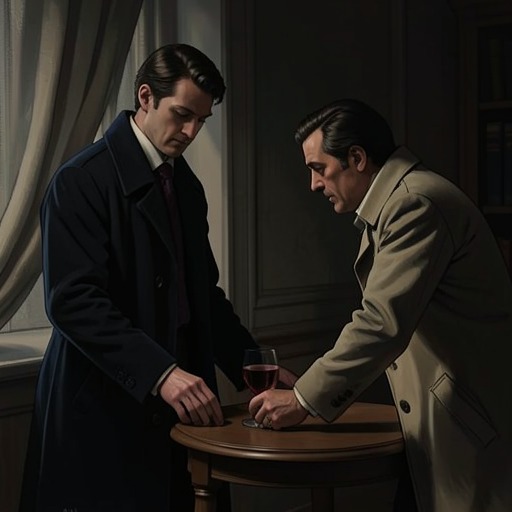
The hypothesis helps explain why Walter insists on a man-midwife, while Mrs. Shandy wants the experienced local midwife to attend her. She has already decided to rely on the older woman, who has practiced in the parish for nearly twenty years and, according to the narrator, has brought every child into the world without an accident fairly attributable to her. Walter nevertheless fears the risks of ordinary delivery and wants an operator whose practice he believes he can influence.
The disagreement is also a struggle over decision-making. Walter argues from private anxieties about the child and from broader political ideas about authority in the household; Mrs. Shandy maintains her right to choose her own attendant. He presses his case in many roles—as husband, father, patriot, and more—while she insists on her own prerogative. Their settlement gives her the old midwife and permits the operator to drink wine with Walter and Toby Shandy in the back parlour, for which he is to be paid five guineas. The outcome does not establish Walter’s preferred method of delivery; it makes the practical conflict over attendance part of the story his hypothesis has set in motion.
The eventual professional alliance reflects Walter’s attempt to find an operator sympathetic to his ideas. Dr. Slop’s newly invented forceps are the instrument he presents as the safest means of delivery, yet Walter has also noticed that Slop’s book gives some support to the method of extraction that occupies his own thoughts. Slop’s reasons are obstetrical rather than Walter’s concern for the soul’s good, but their partial overlap gives Walter grounds to join forces with him.
Significance and limits
Walter’s hypothesis gathers conception, naming, anatomy, childbirth, and intelligence into one explanatory scheme. It gives him a way to treat differences of mind as effects of bodily circumstances rather than unequal souls, but its conclusions remain inseparable from his own conjectures about the brain and the force of delivery. The narration’s account of its growth makes the method visible: examples do not test the hypothesis so much as get absorbed by it.
The theory is comic not simply because Walter reasons at length, but because his intellectual system has practical consequences inside the household. He uses it to support a choice of medical attendant, to imagine a delivery by the feet, and even to consider a procedure that Mrs. Shandy’s reaction makes him drop. Its scale is characteristically disproportionate: a contest over childbirth becomes an inquiry into the origin of wit and the organization of the soul. The hypothesis thereby joins the novel’s scrutiny of bodily experience to its broader interest in how a person’s favored idea can shape what counts as evidence.